Showing posts with label ww2. Show all posts

Thursday, November 11, 2021

PACIFICON 2021

 Well, I finally got around to writing this blog post about the 2021 Pacificon Game Expo convention.   Due to the Covid virus Pacificon 2020 had been cancelled.  Sadly, attendance was down from 2019.  Several of the local gamers had gone to Enfilade instead this year.  Normally, Enfilade is held on a different weekend from Pacificon, but this year it was held on the same weekend.

The miniature and board games were in the same room again, but the room was smaller than 2019.   The number of games offered was also less than 2019.   I ran two games, one on Saturday morning and the other on Sunday morning.   In all there were about 24 people participating in the miniature games  on Saturday.   My Saturday game was Breitenfeld 1631 using Repent or Die from Hoplite Research.   Sorry no pictures and an inconclusive result.  I left early from the convention after my game to take care of some things at home.

My Sunday game was Blenheim 1704  using slightly modified Rank and File rules.   The result was a French victory.   Afterword I participated in the Panzer Korps WW2 game.   I commanded the Germans with the aid of Keith against the two British players.   Our units started out hidden and visibility was limited due to the Bocage terrain.   

The British right flank force arrived first and was immediately thrown back.  After regrouping they again attempted to advance.   Meanwhile my ersatz tank destroyer unit had been sniping at them.

The British left flank force arrived on the second day segment (each day segment is two hours and can have 1-4 turns depending on die rolls).  Their advance was also halted by infantry and our other ersatz tank destroyer unit.   This unit also continued to cause problems for the British left flank for the remainder of the game.   The British never saw it due to attempting to spot the wrong location.   It was further away than where they were looking.

The British also had some offshore naval guns bombarding the area, but this fell on areas where our troops were not deployed..   We had deployed in depth with four infantry (panzergrenadier) battalions up front the two ersatz units behind them, and tank battalion and a nebelwerfer battalion further back.

We also had some anti-aircraft companies that were attached to various units.   The one attached to my ersatz unit caused the British air strike to break off its attack.  Time ran out with the British attack stalled and the Germans still holding all the game area that they had started with.

Below are photos of the Blenheim and Panzer Korps games.

Anglo-allied army on left and Franco-Bavarians on the right.


The following are from the Panzer Korps game
Initial British advance thrown back.   One panzergrenadier battalion on left edge of game area.
My ersatz battalion in its initial starting position, having been spotted by the British after causing them problems
The British regroup and advance again
My ersatz battalion had redeployed to avoid British artillery barrages on its original position.
End of game .   British are no further forward than their initial turn.    I forgot to take pictures of the other flank.


Friday, July 2, 2021

BACK TO CLUB GAMING

With the lifting of Covid restrictions the local game clubs are having face to face meetings. The South Bay Gaming Club is holding meetings at the church again and The Miniature Wargaming Society of Sacramento had a meeting at The Game Castle hobby shop in Sacramento. The community room at the Charmical library where they used to meet is still not available for public use. The Game Castle had a 40K tournament last Sunday so the club was limited to three games. Two were in the private rooms and one was at a table in the main gaming area. There were a lot of well painted 40K miniatures being used in the tournament with at least two dozen players. The three games were Command and Colors Napoleonics hosted by Roger, DBA hosted by John, and Blitzkrieg Commander 2nd edition hosted by Keith. I participated in the BKC game commanding the Russians in the river crossing scenario vs Mike as the German player. The setting was late war about early 1945. The river had four crossing points two fords and two bridges. There was minimal terrain with no high ground, several woods, and several fields. The bridges were in the middle with a ford near each flank. I decided to have one force threaten the left ford and bridge, a second force threaten the two bridges, and the third force at the right ford. Mike was not as experienced with the rules and didn't realize that vehicles could not fire and move. His overall deployment was good otherwise with a strong force hidden in the wood protecting the ford on my right, another in the woods guarding the ford on the left, a third force in the woods between the two bridges, and some Tiger IIs and a Jagdtiger guarding the bridges. I was able to get mutiple activations on the first couple of turns, moving and then firing. Though I took some loses from opportunity fire and for a while Mike had the advantage in losses caused, I was eventually able to turn his flank on my right as I came across the ford. My left and center forces concentrated on taking out enemy units on my left and right as my right flank force came across the ford and the bridge in the center right. Eventually Mike's loses caused him to take a check for exceeding his brak point. Though he passed is position was now untenable and he conceded the game. I didn't take any pictures of the game, but Roger posted one picture of his Napoleonic game on the club's Groups.io forum

Wednesday, February 12, 2020

Battle of Arracourt 1944 at the Fresno Game Club

On February 1st the Fresno Game Club had their monthly game.   The rules used were Rapid Fire.   I commanded the American forces with Neal and James as sub-ordinate commanders.   Dave, Brent, and Jeff commanded the Germans.

My plan was to have the two armored infantry companies in forward positions to delay the German advance.  One company occupied the woods on the north side of the table while the other and the battalion units occupied the southeast village.  Neal deployed in depth further back at the other villages.   I put our Fire Direction Center and the on table artillery at the west end of the table behind the ridge.   I had three forward observers.  Two were placed with James' infantry companies and the third occupied the woods at the center of the table.   I also commanded the re-enforcing engineer and tank companies.

Visibility for the first five turns was limited to 12 inches due to morning ground mist.   The Americans had first fire when units came within spotting distance in the mist.

The Germans arrived in two columns.  One on the northern road and the other near the southeast village.  I directed three of our eight guns on the German forces that had advanced to the top of the hill just south of the southeast village on the first turn.   On the second the other five guns came down on the northern column.   The observers headed towards the rear after calling the fire in order to protect them from being overrun by the advancing Germans.   By turn five they had reached positions on the eastern half of the table.  The artillery continued to fall on the original target areas causing sporadic losses for the Germans and slowing their advance.   James' infantry in the southeast village was eventually overrun, but not before causing more casualties for the Germans than he received.

My observers lifted their fire and proceeded to re-direct it.  On turn seven all eight batteries fell on the leading formations of the northern German advance taking out a Panther  and forced the lead elements to fall back.

James' company in the northern woods was being assaulted by tanks, and multiple infantry units, but was holding on and inflicting more casualties than he was receiving.   As the mist lifted the southern German force could be seen advancing across the open ground towards Neal's forward positions.  Their fire caused several losses including Neal's headquarters element, but did take some damage.   On turn seven the engineers arrived and occupied the southwest village.  The tanks would be arriving on the next turn.

At this point the game was called due to time.   The Americans were declared the victors for preventing the Germans from advancing far enough to achieve their victory conditions.

While Rapid Fire is not too complex and fairly easy to learn the mechanics of the rules do not match the level of play the game is supposed to represent.  Each tank is supposed to be a platoon and infantry is organized as multiple figure companies.  When played with 15/20mm figures towns are represented by two to three buildings.   This would be okay, except that instead of being treated as representations of an area occupied by multiple buildings as it would be at the scale of the game, each building is a single building.   This prevents bazooka teams from firing from within the buildings per the rules.   As such the game plays like it is a lower level skirmish game with individual infantry, vehicles, and buildings.  Artillery fire also deviates more than it did historically and is less accurate.   The rules do take into account the American use of fire direction centers to direct artillery barrages and the ability of American forward observers to call multiple battalions of raillery on a single target.
 Beginning of the game cards represent real and dummy unseen units. The Germans are arriving from their start edge represented by the yellow cards.  American are the chartreuse cards.
 Rear area of the American deployment
 Hellcats ambush lead German unit on the northern road.   The white X marker is the aiming point of the American artillery barrage
 Destroyed vehicles on the north edge.  By the end of the game the Germans would only advance slightly west of the hedge rows where the Hellcats are located.  The woods at the edge were still being contested by American infantry.
Gamemaster Ron in background.  Germans are slowly clearing the village in the southeast.   It took them more than four turns to do so.  White cotton puffs mark smoke rounds from German mortars.

Monday, January 7, 2019

Battleof Sebastopol 1942

Manny Granillo hosted a game of PanzerKorps at his home on January 5th featuring the Battle of Sebastopol 1942.  Sebastopol had been under siege for a while and the Germans and Romanians were about to launch their final offensive to take the city.  Victory conditions for the scenario were such that even though the Russians were likely to loose the battle they might still be able to have a game victory if they were able to hold enough of the city by games end.   I commanded the Russians with the aid of Alan S.   Several other players who were to be on the Russian side were unable to make it due to family illness.   Scott W commanded the Germans aided by Richard and a friend commanding the Romanians and Peter commanding the German amphibious attack.   Alan and I were able to delay the Axis juggernaut for a while thanks to our artillery driving back the Axis attacks.   The amphibious attack was also held for a while, but the devastating effect of a very large German siege gun rendered several of our battalions ineffective.  The battle started at night just before dawn.  A Romanian tank destroyer battalion was able to break through early in the battle, but was attacked from behind by the Russian infantry battalion that it had passed through causing it to panic.   It then came under flanking fire from our reserve T34 battalion which further disrupted it.   Meanwhile German artillery was pounding my positions on the northern edge.  Finally the German panzer force started to arrive from the North.   At this point our western bunkers were still holding, but the amphibious assault had started to wear down the coastal defenders and the northern hill was now being contested.   When the game ended it was a marginal victory for the Axis forces.  Following are pictures of the battlefield and some of the action during the game.
 North edge of the battlefield.  German infantry at right edge ready to attack
north central area looking west
 south central area.  bunkers on the top edge of the table.  what is left of Sebastopol on left half of picture
 central area looking north
 ruins of Sebastopol
 Russian cavalry regiment in reserve, 122 artillery battalion at bottom and T34 battalion at bottom right.
 another view of Sebastopol.
 the peninsula occupied by Russian naval infantry.
 Southwest bunkers with Romanian infantry just below.
 Northwest bunkers and entrenchments with more Romanians just below.
 Germans about to attack the northwest bunker
 Germans preparing to attack from the north
 map of the battlefield showing hills and the city of Sebastopol on south edge of map.
 overall view of the battlefield looking north.
 coastal defenses and ruined sea plane
 blue puff balls showing impact centers of German nebelweffer barrage.
 Russian artillery breaking up Romanian attack and also causing some collateral damage to a bunker.  Romanian tank destroyer battalion that broke through is near the center of the picture after being attacked from rear by Russian infantry.   The T34 battalion is at the left and will maneuver to flank the Romanian vehicles..
 German amphibious forces have landed and have come under fire from the defenders.  The pink puff ball marks the impact point of huge German siege artillery  Three of our battalions would be disrupted for a while due to the impact.   If it had deviated further south it would have also affected the Germans on the coast.
The Romanians had dropped smoke on the bunkers to keep them from firing at them.   T34 battalion at bottom.  Disrupted and panicked Romanian tank destroyer battalion in center.  T34s would move to their right to flank them.   The hill in the middle blocked line of sight and fire.
German panzers arrive from north

Sunday, October 21, 2018

WW2 using Fistful of Tows 3

The game took place at the Miniature Wargaming Society of Sacramento meeting on Sunday October 21st.   The scenario was set in late 1943 on the Eastern Front.   The Russians had broken through the main German line and were advancing towards the west.   The Germans had assembled a kampfgruppe with orders to stop the Russian advance and if possible drive it back.   

The Russians had two T34/76 battalions of six platoons each, a T34/85 battalion of nine platoons, and an Infantry battalion of four submachinegun platoons, two heavy machinegun platoons, an 81 mortar platoon, and two anti-tank rifle squads.   Keith commanded the southern force with one T34/76 battalion and most of the infantry battalion.  Hal had the other two battalions on the northern part of the battle.  The Russians were rated as fair.

The Germans had two PZIVH companies of three platoons, an STUGIII company of three platoons, a Tiger I company of two platoons,, an infantry company of two infantry platoons and an STUGIII platoon, two STKFZ222 armored car platoons, and two 82mm mortar batteries.  Chris commanded the northern force of one PZIV company, the infantry and the mortars.  Mike had the rest of the German armor on the southern flank.  The Germans were rated as good.

The Russians objective was to reach the western edge of the battlefield.   The Germans were tasked with halting the advance and if possible to drive the Russians back.
View of the battlefield from the north with Keith in the background.   A Russian T34/76 battalion with some infantry support is advancing on the left edge of the picture towards the PZIV company at the bottom left center.  The German infantry and mortars have occupied the town at center right.  The t34/85 battalion is advancing towards it.   At the top center Keith's T34/76 battalion and the infantry have occupied that town and the woods along the stream next to it. 


The T34/76 battalion and infantry advance along the northern road.

The first two turns saw both sides advancing towards each other.  The Russians moved first and using strategic movement had almost made it to the center of the battlefield by the first turn.   On the northern flank the PZIV company managed to defeat the opposing Russians with the loss of one platoon.    The southern Russian force dug in and halted their advance at the town.   They took up positions along the wood and town edge which exposed them to fire from the German armor.   This eventually led to their tanks being destroyed or routed by the Tigers and the PZIVs.   One PZIV platoon was driven from the field on that flank.   

The STUG platoon had shifted north and taken up hull down positions on the large hill just to the south of the center town (just above the center town in the top picture).   The T34/85 platoon knocked out the STUG platoon and one of the infantry platoons as it advanced on the center town.   The remaining infantry platoon's morale failed and it withdrew along the lead T34/85 platoon to advance through the town and overrun the mortars.  

The Germans reacted by shifting the northern PZIV company to positions along the western road northwest of the center town   At this point the game was called as a draw.   The Russian advance had been halted, but they had punched a hole through the center and almost made it to the western edge.  The Germans had lost their infantry and part of their armor.   Driving the Russian T34/85s out of the central town would be difficult,   The Russian infantry in the northern town would also be difficult to remove if they withdrew from the edges into the interior of the town.    


Unfortunately I was so busy as the game master that I forgot to take more pictures.   The top photo is courtesy of Mike O'Brian.


Sunday, February 25, 2018

JWW2 Japanese Army and Visitors

Just complete another project.  This is a WW2 Japanese infantry regiment with a supporting tank battalion.  Test of Battle games has released a scenario book for the war in the Pacific called "Road to Tokyo".  Hoplite Research has also released a scenario book on the same subject called "The Emperor's Finest".  While the formation is scaled at one base = one platoon, I can upscale it to one base = one company for "The Emperor's Finest" scenarios.
 The tanks.  Lights on the left.  37mm medium next then the 45mm mediums.
 The infantry.  Three infantry battalions in front.  Supporting guns and engineers in back.

After putting everything away, I noticed that a flock of migrating birds had arrived.   They pass through in the early spring/late winter and late fall.


Wednesday, November 22, 2017

German Attack on Stalingrad

This past weekend Manny Granillo, owner of Hoplite Research, hosted a game of PanzerKorps.  I had the role of Paulus, the German Commander.  Scott Wilson had the 29th motorized division, Rick Pullin had the 94th infantry division, John Arena. had the 24th Panzer division, and I had direct control of the 71st infantry division.   John Cunningham., his son Aydin, and Alan Sissenwein commanded the Russians.  Our objectives were to either capture and hold five of the central building/factory areas or to completely demoralize the Russian army.
Some views of the battlefield

Clicking on the pictures will enlarge them.

View from the north

View from the east

The south edge of the battle from behind the Russian lines.

South end of battlefield from behind German lines.  29th motorized at top right, 94th infantry at right center, 24th panzer west of the river

view of the city  We had to capture the building in the center, the two on both sides of the dice tray, a factory at the top left of the picture and another factory just to the bottom of the picture.

The plan that I conveyed to our army was to spend the first two hour day segment bombarding the Russians and then advance on them.  The 24th Panzer was to hit the hill in front of the south center of the front of the town with two battalions and the built up area to its south with its other two battalions.  94th was to also divide its four battalions into pairs and continue along the front edge of the Russian defenses from the 24th's bombardment.  The 29th was to continue the bombardment from there with its three battalions.   Meanwhile my four battalions fell on the forward positions of the Russians at the north edge of our front.  Our aircraft also came in and bombed the hill and town areas that the 24th was shelling.
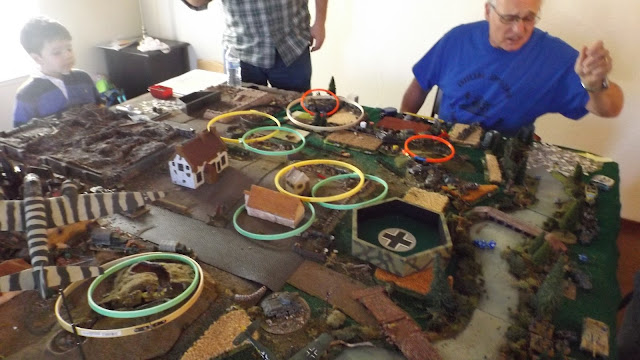

Artillery bombardment rings.  The red and white at the top are Russian artillery landing on the 29th and 94th.  The other rings are ours attacking the hill at lower left and the city.  A total of 11 battalions.

My artillery was able to rout the Russians from their forward positions.  On the other end our artillery was not able to cause as many casualties.  I should note here that Alan, who was commanding the Russians facing me, had bad luck with his die rolls throughout the game, rolling a lot of 1's.  PanzerKorps uses D4, D6, D8, D10, and D12 dice depending on the quality, condition, and type of troops.

The Russians on the south end of their front came out of their fortifications and attacked the 29th motorized division after shelling them with their artillery.   The Russians only had five battalions of artillery to our 15, though they did have a river flotilla in the Volga which ran along the east edge of the battlefield, with additional guns.  These could only be used in line of sight.  The 29th was able to prevail in the hand to hand combat that occurred, though it did have a few battalions bloodied.

bombers attack hill and town.
Scott assesses the situation on his flank as his division engages in hand-to-hand combat with the Russians.  Orange ring is Russian artillery falling on lead elements of the 94th infantry division.

The Russians had two armored brigades in reserve near the center of the city.  One of these was dispatched to aid the southeast and the other was sent to the northern flank.

Routed Russian infantry regiment at left center of picture, arriving tank brigade in town.
My left flank regiment advances

We broke for lunch after the end of the first day segment.  After lunch we returned to the game for the next two hour day segment.

In the south the 94th continued its advance into the city, while the 29th continued to combat more Russians.  In the center the 24th Panzer shifted its four artillery battalions north to attack the center of the Russian front line.  One Kamfgruppe with the Panzers advanced across the river on the road leading to that location while the other Kampgruppe with the STGIIIs advanced along the road in the south center.   The STGs came under fire from the southern Russian armor brigade, but were able to deploy and returned fire.   The panzers were not as fortunate.  they came under fire from the infantry positions in front of them and rolled a one, causing them to take casualties and fall back across the river.  In my area my two lead regiments were advancing with the one on the left making good progress and the one on the right starting to cross the river.  The one on the right had been bombarded by the Russian artillery during the first day segment and now came under more artillery fire as it attempted to get across the bridge.  One battalion made it across, but the others were halted.  The Russians also shifted an additional two battalions of artillery fire from their southern front to the north.  While the regiment on my right was being attacked by two of them, the other two bombarded my regiment on the left.   As a result of the artillery fire three of my battalions in the two regiments had taken some losses.

I now shifted my artillery fire further east to bring the Russian tank brigade, the retreating battalions of their front regiment, and an infantry battalion in the northwest corner under fire.  Again, my artillery fire was effective as Alan's defense die rolled another one.   The three battalions of the forward regiment were destroyed as the survivors scattered.   The tank brigade and the infantry in the corner position both broke and fled..


Russian tank brigade and infantry defending corner have fled.  Four battalions of the 24th panzer artillery attacking the center edge of the town.  While Russian fire falls on bridge to right blocking my advance and heavier guns at the bottom are landing on the rear battalions of my left flank regiment.

24th panzer PzIII battalion crosses the bridge.

Another view of the panzer battalion

The burning hulk of the lead panzer.

At the end of the second day segment we ran out of time and the game was halted.   Although we had taken some losses, our attack on the city was on schedule as the first positions had been taken as planned.  I had forgotten about the rule for free moves when rolling for command initiative.   If I had remembered it, the high rolls I had been making on initiative ( I had rolled a six three times during the five turns of the two day segments), my right regiment would have been across the river, and my left regiment would have been further forward.   I would have also been able to bring on my third regiment and supporting battalions.

Thanks to Manny for hosting the game and feeding us.