Showing posts with label lost battles. Show all posts

Wednesday, July 24, 2013

Lost Battles at the Miniature Wargaming Society (Sacramento)

This past Sunday I drove up to the Sacramento area to visit the Miniature Wagaming Society.  I had been in contact with Greg on the MWS yahoo group about playing Lost Battles.   The MWS meets at the Carmichael Library.   They have use of a large room with a lot of tables and chairs.   The main game being played was Gettysburg using Volley and Bayonet rules and 3mm figures.   There were three other board games also being played.

Greg and I managed to play three different battles from about 10 in the morning until 3:30 in the afternoon with a half hour lunch break.   The three in order of play were Marathon, Raphaia, and Hydaspes.  We used my 6mm figures and had the rule books from the board game.  The figures are a mix of Bacchus, Rapier, Heroics and Ros, and Irregular.   All the hoplites and phalangites are from Rapier.   The Indians are mix of Bacchus and H&R.   The Persians are a mix of Bacchus and Rapier with some H&R cavalry.  The games were played on a felt mat with 14 inch squares on a 5 foot by 6 foot table.

For the first battle Greg was the Greeks and I was the Persians.   Although I almost broke through the Greek center my army was destroyed and Greg won on points also.  The following photos are from that game showing initial dispositions and the end of each turn.   
The Greek army
Persian army
 The armies close


 Persian flanks destroyed
The Greek flanks close in.

Raphaia was a nail biter as both armies hacked away at each other leaving only a few remaining units on the Seleucid side.   Greg was Ptolemy and I was Antiochus.   The Seleucid army was modified slightly to match the scenario in Strategos by replacing the levy phalanx unit with two average units.   This gave an equal fighting value to both sides.   There were several points during the game where one die roll would have decided the outcome in favor of either side.   The Seleucids quickly drove off Ptolemy's cavalry on their right flank, but their elephants and infantry in the adjacent zone were defeated by Ptolemy's forces.   Antiochus made a valiant charge against the flank of Ptolemy's center.  Eventually Ptolemy's army's morale collapsed and the remaining Seleucid units were left on the battlefield to claim victory.   Afterwords, Antiochus was heard to mutter that he was thinking of changing his name to Pyrhhus.
Seleucids on left, Ptolemy on right
view from Ptolemy's side
Antiochus routs opposing cavalry


Argyraspids fled from the field.
 Ptolemy's left flank turns towards the center.
Remains of the Seleucid army.

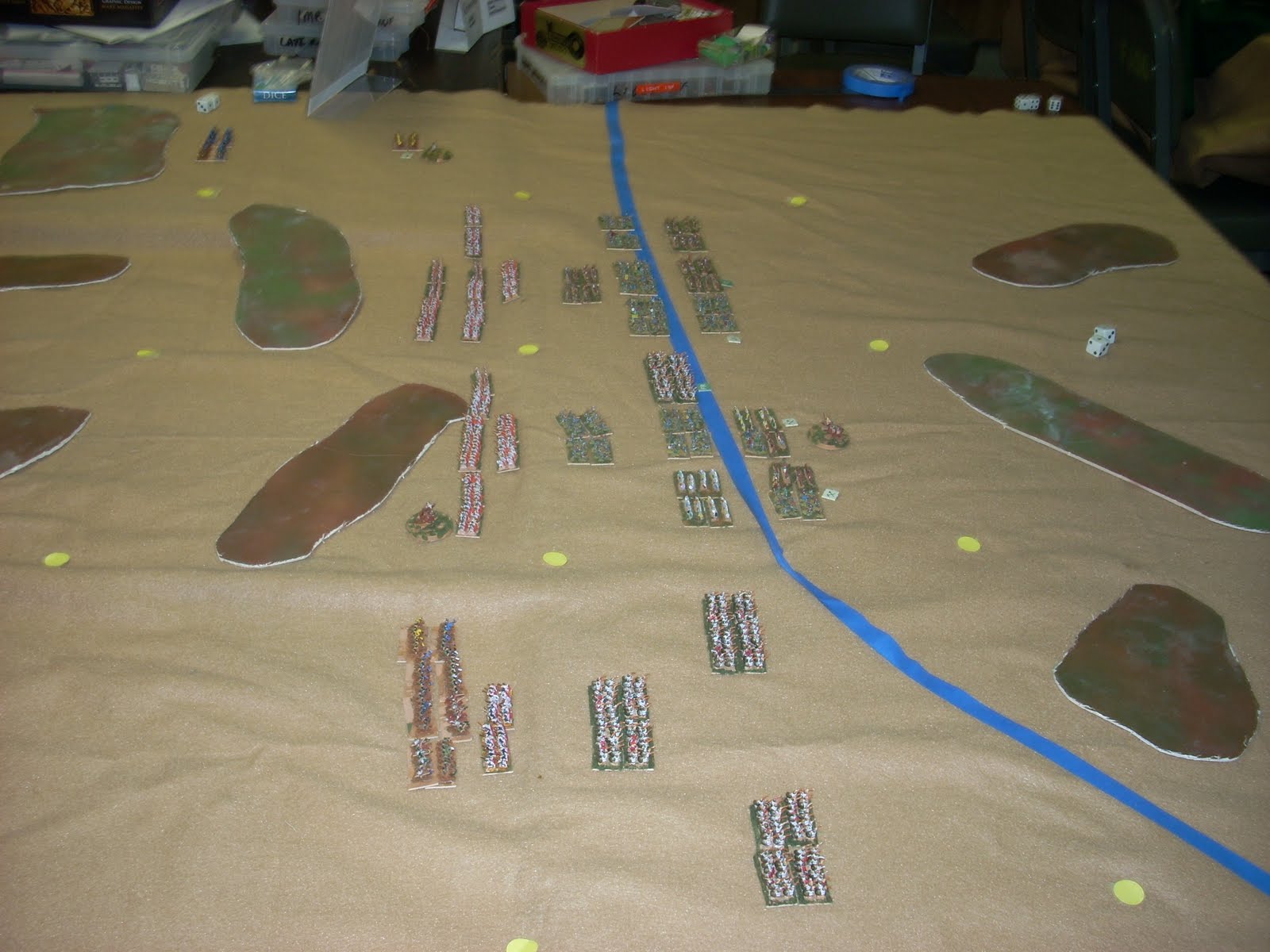
The final battle was Hydaspes.  Greg and a new club member (my apologies, but I have forgotten his name) commanded the Indian army and I was Alexander.   Instead of playing cautiously I played as Alexander and rashly made several all out attacks.   The resulting points loss for spent units gave the game victory to Greg though the Indian army was driven from the field.  Greg is on the right in black and the new member is on the left.
Indian starting positions
 
  Macedonian starting positions.
Early part of the battle.  Alexander's cavalry wing would be held up for several turns as it was unable to score enough hits to eliminate the opposing cavalry.
Macedonian left flank cavalry eliminates their opponents and would sweep around to the rear of the Indian army.  Alexander reserved the turn reversal until the following turn, allowing his troops to take advantage of the openings in the Indian line.
I would like to thank Greg for an enjoyable afternoon and for being a worthy opponent.  The Carmichael Library was a great place to game at.   There were quite a few eating establishments within a short distance of the Library.

Monday, October 10, 2011

First Raid convention

This past weekend I was at the First Raid convention in Alameda, Ca. Although attendance was not crowded, there were a number of very good games and people had a good time. I enjoyed it and would definitely attend again. Thanks, Dan for putting on a very good gathering. The event was held at the Naval Air Museum in Alameda with all entry fees ($800) going to support the Museum.

The first photo is of Ed Texeira of Two Hour Wargames on the left, myself, Rob Schmidt, and Dan Rygasewicz, organizer of the convention. The second one is of Dana Lombardy giving his seminar. The others are from the Saturday games. In order they are Stalingrad, Battle Cry ACW, Rorkes Drift, Tsushima, PanzerKorps attack on Peleliu Island. One game I failed to take a photo of was the Fire and Fury ACW game fought on a 5 foot by 18 foot table.


After finishing the ancients tournament I participated in the PanzerKorps game as the Japanese commander. By the time the game ended the US Marines were in a precarious position. In the third photo only four companies were still on the beach head with the two at the top and one at the bottom of the photo in serious trouble. The Japanese had a company with tank support in reserve that was about to advance and fire on the two companies at the top, which Manny determined would cause them to be lost. This was my first time playing Manny Granillo's rules and they very good and fun to play.

The final set of photos are of the Lost Battles Ancients tournament. There were only two participants, Tom McThorn commanding the Romans and Rob Schmidt commanding the barbarians. Since both were fairly new to the game system the battle of Bibracte was chosen for the game as it had armies matching their choices. Per the tournament rules Rob's army was adjusted to a fighting value of 73 by adding an Inspiring commander and an average commander.
The battle lasted four turns and ended with the last of the Helveti routing from the battle. Rob had managed to destroy the Roman cavalry on his right and had moved his cavalry into the Roman rear using his average commander. His left wing cavalry had also shattered the one reserve veteran legion that it faced. Although one other Roman veteran legion had been shattered in the center, Roman morale had held throughout the battle. Tom had captured both of the Helveti flanking center zones. Almost all Roman units were spent, but by the end of the game Tom had shattered nine units of Helveti warriors, and all the other Helveti were spent. Final score was 118 to 69 with the Romans winning. None of the generals were lost during rally attempts. Thanks to both for participating.


Thursday, March 3, 2011

Battle of Hydaspes using Lost Battles

My friend, Steve, who is a high school teacher, asked me to put on a game for the schools wargame club. I chose the Battle of Hydaspes as it involves most of the different Lost Battles troop types. Steve took the part of Porus, while three of the club members took the parts of Alexander, Coenus, and an unnamed Indian subordinate.

The figures for the Indian army are a mix of Baccus and H&R infantry, Irregular and H&R cavalry, H&R chariots, and elephants from H&R, Baccus, and Irregular.

The Macedonian phalanx are from Rapier. The light infantry are H&R. The light cavalry are H&R and Rapier. The Companions are Baccus and H$R.

first turn
The Indians moved their units in the rear and wing zones to form a solid battle line ending their first turn. The Macedonians advanced their units to their forward zones and elected to use all their extra command points to provide a bonus to all their units attacking from their right center. However, they were only able to reduce one of the opposing elephant units to spent.
Second Turn
At the start of the second turn, the Macedonians decided to reverse the turn order and move first. Taking advantage of their command exemptions they attacked with their cavalry on both flanks and the infantry in their center zone, but were only able to reduce a few of the chariots and cavalry to spent. alexander had elected not to lead the charge on the right flank. The Indians then counter-attacked and the elephants battered the Macedonian light infantry. The Indians also advanced from their right center into the Macedonian left center, threatening the flank of the phalanx.

Third turn.
Alexander now boldly led the attacks for turn three. One Indian chariot unit was shattered and one Indian Elephant unit in the center was also shattered. The remaining Indian mounted forces also became spent. The Indians passed their morale tests and retaliated causing some damage to the Macedonians. All the phalanx units became spent and Alexanders bodyguards received two hits. Luck was with Alexander as he removed both hits.
End of turn four.
Turn four was a disaster for the Macedonians. Although they shattered some more Indian units and Coenus drove off all the opposing forces and advanced into the Indian right flank zone, the Indian army remained steadfast. Their attacks were devastating. Alexander received another hit, but was able to remove it. The Macedonian Phalanx did not fair as well as three of the veteran units and one of the average units were shattered. Even with almost all their infantry gone the Macedonian morale held as they rolled another six. During the battle almost every die roll for morale tests was a five or better with a couple of fours. However, this was not to last. On turn five Alexander again led the attack. Scoring only a die roll equal to the number required, Alexander elected to make an all out attack shattering the opposing cavalry. This caused another morale test for the Indians. This time their die roll was only a one and with that all of their remaining units except those in the Macedonian left center zone fled from the field.

Due to time constraints the game was called at the end of turn five. The points for units spent, shattered, etc for both sides were almost equal, but the bonus for the initial points differential resulted in a clear victory for the Indians.