Showing posts with label guano wars. Show all posts

Sunday, March 15, 2020

South Bay Gaming Club meeting March 14

There were four games at the club meeting today.   Form on the Admiral's wake (age of sale0 rung by Bob,  American War of Independence in 54mm run by nick,  WW2 air run by Chuck, and a fictional modern armor game run by me.

This was the battle of Salon de Companerismo had the Union Federal de Buena Vista first division fighting the first division of the Republica  Democratica Popular de la Cucaracha.   The UFBC first division had three combat brigades and one divisional artillery brigade.   The combat brigades had one brigade with two tank battalions, two puma battalions, an engineer battalion and one artillery battalion, one brigade with one tank battalion, three puma battalions, one engineer battalion, and an artillery battalion, and one brigade with three boxer battalions and an engineer battalion.   The divisional artillery brigade had three MRL battalions and one AA battalion.

The RDOC had a brigade with three tank battalions, one BMP battalion, and an raillery battalion.  The second brigade had two tank battalions, two BMP battalions and one artillery battalion. The third and fourth brigades had one tank battalion, one BMP battalion, two BTR80a battalions and one artillery battalion. The divisional artillery brigade had three artillery battalions, one MRL battalion, and one AA battalion.

The rules used were Lightning War - Red Storm, which are available for free from  LWRS group.io   We did use some house rules for the game as we kept the ground scale to one kilometer per 10cm (four inches) instead of the recommended doubling for the modern period and  changed the quality ratings by increasing them by 5 and using a roll of two dice instead of a single die roll for activating formations.  The table was 24km square.

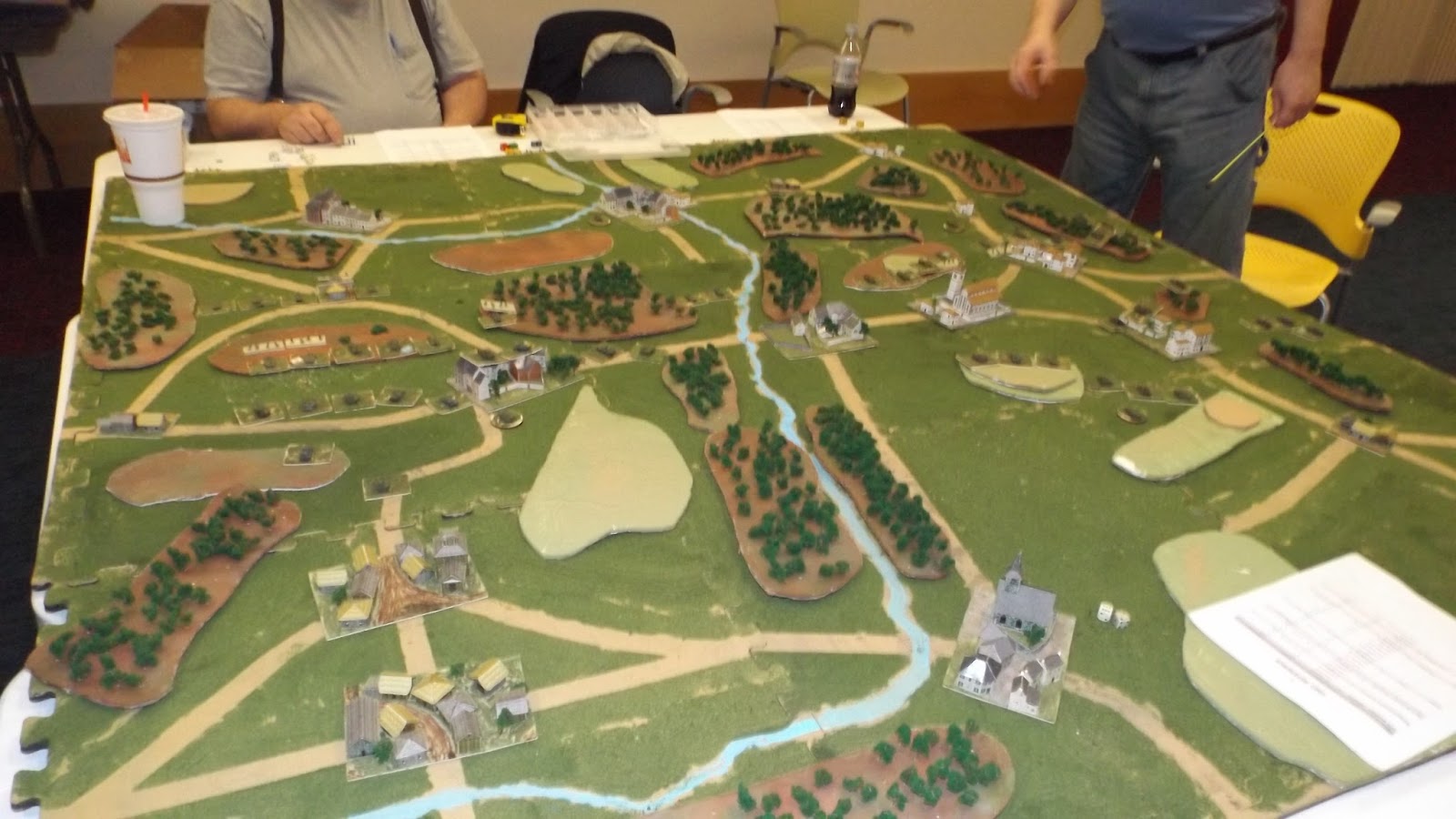
View of the battlefield from the northwest

At the start of each turn two six side dice were rolled for each brigade and any modifiers are added.   For this scenario there were none.   Both sides were rated as good with a rating of 8 for all units except the RDPC artillery brigade. which was fair with a rating of 7  The die roll is used to determine the order of activation for each combat formation (brigades for this game). The score for each of the formations on both sides determines the order of movement for the turn.   The highest score can move first or choose to move later in the turn.  This gives the higher scores an advantage over lower scores as they can choose to move when it is to their best advantage.  The next higher score now has a choice of moving or deferring their move to later also.   The same applies to each formation in turn and can force the formation with the lowest score to move first.  This process is repeated until all formations have moved.

Indirect fire is then resolved followed by  direct fire.   It is possible for artillery fire to disorganize a formation which would then cause it to only fire with half its combat factors.   Artillery fire is not guaranteed as the unit calling the fire has to roll equal to or less than the artillery formations quality rating and calling divisional artillery has an additional negative modifier applied to its rating.  Artillery fire is very good at disorganizing units, but causing casualties on armored units is difficult due to the save modifiers.   Infantry in built up areas can also be very difficult to cause casualties on.

The UFBV used march and road movement to move quickly forward and gain a positional advantage over the RDPC.   At first casualties were very light.   The RDPC was advancing from the east and managed to occupy the town on the south center edge of the battle field.   The UFCV advanced towards that town and prepared to storm it with a pair of infantry battalions.  Artillery and direct fire had disorganized the DRPC defenders. If the UFBC could roll high enough for initiative on the next turn the two battalions would be able to move first and assault the defenders before they were able to recover from disorganization.  They were able to do so and their assault drove the defenders from the town.


View of the town on the turn prior to the assault on it.

Center of the battlefield on the same turn viewed from the southeast

Attacks by the RDPC to the south of that town were halted and driven back  In the center part of the table UFBV artillery and direct fire badly damaged another couple of RDPC battalions.

On the northern flank neither side was making much progress.   Artillery and direct fire from a Leopard 2 tank battalion damaged another BTR battalion.

Combat had taken a full rules day of six turns.  Both sides paused for the night and combat resumed in the early morning of the next day.  At this point UFBV artillery and direct fire took a toll on RDPC units. By the end of turn eight the two RDPC brigades on the southern half of the table had two exhausted battalions with possibly more by the end of the next turn.  It was judged a UFBV victory. We had played for about four hours with a short lunch break included.      


End of turn five.   RDPC tanks would occupy the hill in the left center and their infantry would occupy the town to the left of it.  UFBV infantry would advance up the road towards the town and the tank battalion on the road in the right center would advance through the town in the bottom center then deploy above it.
                                                                                                             
We have tried several different rule sets including Fistful of Tows, Spearhead, Cold War//Blitzkrieg Commander and others.   These played the fastest of all of them and were easy to comprehend and use.  The rules are available for free from https://groups.io/g/LWRS

Friday, June 29, 2018

NATO Three Color Camouflage

In the mid 1980's the United States and Germany agreed to adopt a new camouflage pattern using a combination of green, grey-black, and red-brown.   They also devised specific patterns to be used on each type of vehicle.    There is a US army field manual  tb43-209   with almost all the patterns for each vehicle in it.   The Team Yankee website also has PDFs of some of the German paint diagrams  A website with paint diagrams for German, US, French and other nations is Panzerbaer  Be advised though that the diagrams for the French vehicles have green and black reversed.   Where it shows green it should be black and green where it is black.

Vehicles primed with green spray primer from Amazon (local OSH store used to carry it, but not anymore), then black, and finally red-brown spots using a 10/0 brush.   Black and Red-Brown paint from Stone Mountain Miniatures this time and on the Terminator and Cimmerian in a previous POST  I have used GHQ paints on some previous  batches and for some scifi vehicles

 TPZ vehicles for Union Federal de Buena Vista
Leopard 2A6M for Union Federal de Buena Vista


For those who are doing the earlier US army MERDC scheme this manual will be helpful

Sunday, April 1, 2018

The battle of marconi

The war between La Union Federal de Buena Vista and La Republica Democratica de los Pueblos de La Cucaracha continues.   A recent engagement occurred at the border town of Carmichael between two brigades of UFBV and two brigades of RDPLC.  Reports from the battlefield are contradictory with both sides claiming victory. 

Forces involved were the 2nd and 9th brigades of the UFBV and the 6th, 9th, and 10th brigades of the RDPLC.  UFBV uses German equipment while RDPLC uses Russian.  The UFBV brigades had only one company each from the engineer and recon regiments.   For organization information and links to both sides forces see  Buena Vista army

This was a meeting engagement between the two modern imaginations and came to a halt when two participants had to leave about four in the afternoon.  It looked like the UFBV was gaining the upper hand, but the RDPLC still controlled more of the towns when we halted.

This was a learning game for us.  We had decided to try Fist Full of Tows 3 to see how it compared to other rule sets we have tried.   The rule book is rather large and somewhat expensive, but it covers everything from post WWI to almost the present day.   With a discount coupon from LULU it costs the same as purchasing both Blitzkrieg Commander and Cold War Commander and a lot less than flames of war..  Much of the book is devoted to equipment data, instructions for how to determine statistics and point values and some organization examples along with ratings for World War II nations and most of the modern day nations.  The rules are well laid out with a basic outline of each rule at the beginning of a section and a more detailed explanation with examples following.   The mechanics of the rules are easily understood and after a turn or two do not require checking the rule book for clarification.   We did not include aircraft for the first game and will be adding additional items as we play further games.
 Start of game. Brian moves his brigade onto the table
 UFBV commanders Hal and Mike move  their brigade on while Chris watches.
 Gary moving his brigade onto the table
  Brian's mechanized battalion takes up a position on the ridge after his advance is halted by UFBV forces.

 DRPLC forces defend positions as UFBV advances.  Chris was able to cause more losses than he received.
 both sides were able to get troops into the town at the center 
DRPLC tank battalion in center of picture is destroyed by UFBV tanks on hill in the background.

Sunday, February 18, 2018

Restructuring of the Federal Union of Buena Vista Army

A while back I had posted the organization of two fictional modern era countries:  The Federal Union of Buena Vista  and The People's Democratic Republic of La Cucaracha   The new organization of the Federal Union of Buena Vista's army will consist of ten brigades.  These will be as follows:

1st Presidential Guard Brigade: 8th Lifeguard Tank Regiment, 14th tank regiment (Dragoon Guards), 11th,12th mechanized regiments, 18th reconnaissance regiment (Hussars), 4th engineer regiment, 34th artillery regiment, 40th logistics regiment,

2nd Mechanized Brigade: 20th Tank regiment (Dragoons), 24th mechanized regiment , 1st motorized regiment (Rifles), 7th reconnaissance regiment (Light Dragoons), 48th engineer regiment, 25th artillery regiment, 47th logistics regiment

3rd Light Infantry Brigade:  21st, 22nd, 23rd motorized infantry regiments, 16th reconnaissance regiment, 3rd engineer regiment, 45th artillery regiment, 28th logistics regiment

4th Mechanized Brigade: 44th, 46th mechanized regiments, 43rd motorized regiment, 6th reconnaissance regiment (Light Dragoons), 38th engineer regiment, 32nd artillery regiment, 42nd logistics regiment

5th Artillery Brigade:  52nd, 53rd MLRS regiments, 56th air defense regiment, 41st logistic regiment

6th Airmobile Brigade : 36th attack helicopter regiment, 26th, 31st airmobile regiments, 10th, 30th transport helicopter regiments, 15th reconnaissance regiment (Hussars), 27th engineer regiment, 60th ground support regiment.

7th Mechanized Brigade:  5th tank regiment (Cuirassiers), 2nd, 37th mechanized regiments, 13th reconnaissance regiment (Hussars), 17th engineer regiment, 35th artillery regiment, 58th logistic regiment

8th Artillery Brigade:   51st, 54th MLRS regiments, 57th air defense regiment,70th logistic regiment

9th Training Brigade: 39th tank regiment (Carabiniers) (training), 33rd mechanized regiment, 29th mechanized regiment (training), 19 motorized regiment (training), 9th reconnaissance regiment (Uhlans) (training), 49th engineer regiment (training), 59th artillery regiment (training), 69th logistics regiment (training).

10th Territorial Reserves Brigade:  63rd reconnaissance regiment (cadre only), 61st, 62nd motorized regiments, 64th motorized regiment (cadre only), 50th artillery regiment, 55th engineer regiment (cadre only), 65th logistics regiment

All regiments are single battalions with three combat companies except for airmobile regiments, artillery regiments, and MLRS regiments.  Air mobile regiments have three combat companies, a weapons company, two commando companies, a medical company, a training company, a reserve company, and a logistics company.  MLRS regiments have two batteries.  Artillery has four batteries of four guns.  Tank regiments have Leopard 2A6.  Mechanized Regiments have Puma IFV.  Motorized Regiments have Boxer IFV except for the 3rd Light Infantry Brigade, which has Boxer APC's in the 22nd and 23 regiments..  Brigade Artillery Regiments have PZH2000.  Attack Helicopter Regiment has Tigre. Transport Helicopter Regiment has NH90.  Air defense regiments have two Gepard companies and two Roland companies.  There has been some discussion regarding separating the infantry formations from the helicopters of the airmobile brigade, creating two separate brigades, and placing them with the 10th territorial brigade under a third division command.

The army has two division headquarters that serve as administrative commands.   The first division has the 1st, 3rd, 5th, and 7th brigades.  The second division has the 2nd, 4th, 8th, and 9th brigades.

Sunday, March 13, 2016

OPFOR at South Bay Game Club

The Battle of Santa Clara

At the March meeting of the SBGC I ran  OPFOR  the modern warfare supplement for PanzerKorps from Hoplite Research.  Manny Granillo commanded the 7th Brigade of the Peoples Democratic Republic of Cucaracha army, consisting of one T90 battalion, two BMP2 batalions, two BTR battalions, and one SP122mm artillery battalion.   Greg commanded the German Brigade of the Federal Union of Buena Vista consisting of two Puma battalions, one Leopard 2A6 battalion, and one SP155 battalion.

The La Cucaracha infantry battalions each had a 120 mortar battery attached.  The brigade also had three ATGM companies,  two recon companies and three FOs available for attachment to any battalion.   The La Cucaracha brigade was rated as reservists.  The commander was rated as career.  Each battalion received one decorated leader and two decorated leaders were kept at brigade level.

The Buena Vista battalions each had four companies.  The tank battalion cross attached two of its tank companies with the two infantry battalions.  This gave the two infantry battalions three Puma infantry companies, one Leopard company, one mortar battery, and one FO.  The tank battalion had two Leopard companies, two Puma companies, and an FO.  There were also two recon companies and one ATGM available to be attached to any battalion.  The tank battalion received a recon company and the infantry battalions split the other two companies.  The Buena Vistans were rated as regular.   Each battalion received two decorated leaders and one decorated leader was kept at brigade level.  Both sides  used red decision dice.

The game was played at one centimeter = 100 meters instead of the one inch = 100 meters scale on page 6.  Direct fire ranges were adjusted accordingly and converted to inches.   Movement was kept at the full amount of inches per turn instead of reducing to centimeters.   The battlefield was six feet square.  This converts to an 18km by 18km area.  The companies are based on 50mm(two inch) wide bases. At this scale a battalion could cover and defend a 5km wide zone as mentioned in several cold war documents.
Several views of the battlefield.  The buildings are from PaperTerrain.


Greg won the initiative for the first day segment and rolled for four turns.  His battalions entered in three separate zones.  Manny chose to enter in two road columns on the left half of his edge.  The opposing forces were unable to see each other until the fourth turn of the first day segment.  The Buena Vistans made use of cover preventing them from being seen, but were able to see the advancing La Cucarach forces and opened fire with the two infantry battalions at long range causing minor damage.   The Buena Vista tank battalion bogged down and did not advance for two turns due to low activation die rolls.   The Buena Vista army had a +1 die modifier for the decorated leader, but a -3 modifier for only having four battalions.
Towards the end of the first day segment.  Buena Vista on the left.  La Cucaracha on the right.
La Cucaracha infantry advances towards the central town.

Greg again won the initiative for the second day segment and rolled for three turns.   He immediately brought his artillery down on the two La Cucaracha infantry battalions near the middle of the table.  His middle infantry battalion advanced to the central town, while his right flank infantry battalion exchanged fire with the La Cucaracha tank battalion.   Almost every time Greg fired with the infantry battalion he would roll a one on the attack die.   What allowed his battalion to cause damage were the modifiers for the attachments.   These were +2 for the Leopard company +1 for the mortar company, +2 for the ATGM company, +1 for the Puma weapon modifier, and +2 for being equipped with ATGMs.   There was also a +1 for being at short range.  This was reduced by -2 for the T90 defense factor.
Buena Vista forces occupy hills east of the towns.
While the T90s engaged the opposing Buena Vista infantry battalion the two infantry battalions behind them moved towards the center of the table to help the other two infantry battalions that were having difficulties with the other Buena Vista infantry battalion and the artillery barrage.  The other Buena Vista infantry battalion had fewer die modifiers due to not having the ATGM company that the other had.   One of the two center La Cucaracha infantry battalions had taken too much damage from the artillery barrage and was unable to advance.   The other one was able to advance, but was driven back by the opposing Buena Vista infantry losing a decorated leader and the mortar company..   As it was being driven back the Buena Vista tank battalion had finally arrived near the central town, having spent several turns consulting their maps and asking directions from the local peasants. 
Fighting intensifies.  The two La Cucaracha infantry battalions on the left would come under artillery fire during the second day segment when east (right of the town on the left.

Manny won the initiative for the third day segment and rolled for two turns.   He had brought the two left flank infantry battalion up on the hill overlooking the central town during the previous day segment.  Greg had also moved his central infantry battalion up on the hill and the Leopard battalion in front of the town on the previous turn.   Manny called in his artillery on the infantry at the hill and forced them to fall back, losing one decorated leader and the recon company.  The fire from the Leopard battalion was devastating to the two infantry battalions that were caught in the artillery blast zone.   Other than the one turn where one of them had advanced towards the town, they spent six turns within the artillery blast zone.   The Leopard battalion had the following modifiers to its die roll.  -2 for being only two companies, +4 to its fire die, +1 for each for each of the two Puma companies, +2 for ATGM on the Pumas, +1 for the recon company, and +1 for superior weapon.
Leopards making short work of the opposing infantry.   One battalion has already routed and the second would soon follow.   The Buena Vista infantry battalion on the top right had just fallen back from the artillery fire (white die on top of other hill), but would soon recover and rout the opposing infantry battalion.

The Leopards caused both infantry battalions to rout, while the central Buena Vista infantry battalion was able to rout another infantry battalion.   At this point the La Cucaracha army morale failed and they withdrew from the battle.  Greg's plan for the next few turns was to pin the two infantry battalions and tank battalion with his two infantry battalions while the Leopard battalion finished off the central infantry battalions and then sweep around behind the La Cucaracha right flank.

Miniatures are from GHQ.  Buildings are from PaperTerrain.  Trees are from an Ebay dealer.  Battlefield is two foot square interlocking rubber tiles 

 The battle started about 11:00 as several of the club members had brought items for sale, trade or for free.   Thanks to Lawrence for giving me a copy of Vis Bellica.   We finished about 1:15.  This was an average of one turn every 15 minutes.  Using the 1cm = 100 meters scale, while keeping the full normal move resulted in a more dynamic and quick moving game.   The opposing forces were able to maneuver without becoming completely bogged down in a linear slugging match.  Force density was also about the same as that of the Second Armored Divisions attack on the Medina Division during the First Gulf War.   For those who may be interested in reading about the First Gulf War there is a free book from the army center with maps of the battles at Jayhawks  The Second Armored attacked the Medina division on a 30 km front (a ten foot wide table at 1cm = 100 meters)


Saturday, March 12, 2016

5Core Brigade Commander playtest

We did a playtest of 5Core Brigade Commander at the January Miniature Wargaming Society of Sacramento meeting.   Gary, Hal, Keith, and Rob took part in the game.   Both sides had twelve tank companies and twelve mechanized infantry companies.   We did make a few modifications to the rules for the game.   Ground scale was altered to 1 cm = 100 meters from the 1 inch = 100 meters, a dismountable infantry base was added to the IFV base allowing the infantry to dismount to occupy terrain while the IFVs moved in support,  and a pair of dice was used for activation instead of the single 6 sided die.   This was done to cut down on the frequency of scurry or firefight turns.   If the dice matched and were even then it was a firefight and if they matched and were odd it was a scurry.   Otherwise the total of the two dice was added to three and that was the number of company sized formations that the player could move.   Each player rolled for their own command and had twelve companies.

Another modification we made was to the activation rules.  Normally only one third of the units are activated per turn with a minimum of three.  We changed that to 3 plus the total of the two dice rolled at the start of each turn.

We did not use any of the attachment rules.   These are smaller than company sized formations that are added to a company base providing enhancements such a s Recon, Engineer, AA, etc.

Overall the game played faster than other rules we have used and reached a conclusion.  Discussion after the game suggested changing the activation rolls to only a matching pair of ones for a scurry turn, and a matching pair of sixes for a firefight.   It was felt that scurry turns happened with too much frequency.

There are a number of problems with the ground and unit scales and weapons ranges.   The rules state that  one inch  = 100 meters and troops should be based on 3 inch stands though the basing is contradicted later in the rules.  The problem with this is that the minimum frontage for a company is 500 meters or more.  This would be a five inch base.   Since my models are mounted on 5cm bases the ground scale was altered to 1cm = 100 meters.   Movement and weapons ranges were left as they were in the rules.   This fixed a problem with the weapon ranges.   In the rules the normal range for a tank gun is 12 inches with an extended range of 18 inches for advanced sights.   This would only be 1200 meters and 1800 meters respectively.  This would be fine for World War 2, but not for contemporary tanks with ranges in excess of 3 kilometers.   Changing the ground scale resulted in a normal range of 3000 meters and an extended range of 4500 meters.

Another problem is the artillery rules and terms.   The author uses "packets" for small amounts of indirect fire weapons attached to companies, but does not define the term.  Depending on army and organization this could be anywhere from 2 to 6 or more indirect fire weapons.  An example is given of a Soviet artillery battalion being broken up and a battery attached to an infantry or tank company.  The other term is the stonk.   The problem with this term is that the number of batteries that compose a stonk is not defined.   Packets fire a single suppression die, while stonks use a kill and two suppression dice.   The question is - are all three batteries in an off table battalion used together to create a single stonk or does each battery fire its own stonk?  There are other problems with the indirect fire rules that do not take into account the capabilities of some nations to direct a lot of accurate fire from multiple battalions of artillery or the inability of others to direct more than a single battery.

I don't know if we will use these rules again.   We still have a couple more sets of rules to try.  These are FFT3 and OPFOR.

We played the game on the 2x2 rubber mats that I got from Amazon.  I have finished painting and texturing half of them.  I put the road in the center of each edge and offset the water ways by 4 inches.   This was done to allow the water ways to avoid straight lines and 90 degree forks.  This also allows a greater variety of forks than placing the rivers in the middle of each edge.

Below are some pictures from the game.

 The game table 
 another view
 opposing forces engage.
 Action between Keith and Hal.
 Keith, in front, and Hal
 Gary, on the left, and Rob
Action between Gary and Rob


Tuesday, November 24, 2015

The Federal Union of Buena Vista Army

The Buena Vista army is organized into brigades of two tank battalions, one wheeled mechanized infantry battalion, one tracked mechanized infantry battalion, two self-propelled 155 artillery battalions, an air defense company, and a combat engineer battalion.

Tank battalions have four companies of three platoons, two recon elements, a 120mm mortar battery, a forward artillery observer, a headquarters section, and a tactical operations section that functions as a second headquarters unit.    Mechanized battalions have four companies of three infantry platoons, two recon elements, a 120mm mortar battery, an ATGM company of three platoons, a forward observer, a headquarters section, and a tactical operations section.  Artillery battalions have three firing batteries.  The engineer company has two combat engineer platoons and a vehicle launched bridge platoon.   The anti-aircraft company has one missile platoon and one gun platoon.

The country's president for life, Elvis Narcisso, likes to indulge in purchasing tanks and vehicles from different countries.   Currently there are four brigades in the Buena Vista army.   One brigade has American equipment, one has British equipment, one has French equipment, and one has German equipment.   Attempts are being made to purchase equipment from Israel to equip a fifth brigade.

The Buena Vista army is an all regular force and is well trained and equipped.   Low level initiative is encouraged.    The overall size of the army is smaller than that of La Cucaracha.  Older equipment has been moth-balled.  Troops who retire from the army are part of an inactive reserve that could be called into service to use the older equipment should the regular army be decimated.

Buena Vista and La Cucaracha have had a long lasting dispute over a region on their border that has large reserves of oil.   Both countries have used their income from oil sales to equip their armies.

Sunday, November 22, 2015

The La Cucaracha Army

Theoretically the La Cucaracha army is organized into two divisions, each consisting of an armored brigade, a mechanized brigade, two motorized brigades, and  an artillery brigade.  The divisions are administrative formations.  The First Division has the 1st Motorized, 3rd Tank, 4th Guards Mechanized, 6th Motorized, and 10th Artillery brigades.  The Second has the 2nd Guards Tank, 5th Motorized, 7th Mechanized, 8th Artillery, and 9th Motorized brigades.  Except for the 2nd and 4th Guards the army is composed of conscripts and tends to lack initiative at lower levels, though overall training is good.

The armored brigade would have three tank battalions, one mechanized battalion, one self-propelled 122mm artillery battalion, and brigade assets,    The mechanized brigade would have two tank battalions, two mechanized battalions, one self-propelled 122mm artillery battalion, and brigade assets.   The motorized brigade would have one tank battalion, one mechanized battalion, two motorized battalions, one self-propelled 122 artillery battalion, and brigade assets.   The artillery brigade would have three self-propelled 152mm artillery battalions, and one multiple rocket launcher battalion.  All artillery battalions have three firing batteries and a forward observer platoon.   The forward observers can be assigned to combat battalions as needed or function on their own.

The tank battalions have three ten tank companies and a headquarters element..   In game terms this would be six platoon sized elements plus a headquarters element.   The exception to this is the 4th Guards Mechanized Brigade which has thirteen tank companies which would be nine platoon elements in game terms.  There are plans to increase the strength of the other tank battalions to match those of the Guard.  The infantry battalions have three infantry companies, each of three platoons,  an anti-tank platoon with man portable ATGMs, an 82mm mortar platoon, and a headquarters element.   A mechanized battalion would have BMPs and a motorized battalion would have BTRs.   The mortar platoons use MTLBs.

Brigade assets include an anti-aircraft company of one ZSU platoon and one SA13 platoon, a recon company of three BRDM platoons, an anti-tank company of three BRDM ATGM platoons, a 120mm mortar battery, an engineer company of two combat engineer platoons riding in BTRs and an MTU bridge layer platoon, and a headquarters element.

In reality the army is not as well organized as listed above.   Brigades vary in strength from two to six combat battalions.  The composition of the brigades, plus the brigade assets and artillery battalion, is as follows:

1st Motorized Brigade - two tank battalions, one mechanized battalion, three motorized battalions
2nd Guards Tank Brigade - two tank battalions and one mechanized battalion
3rd Tank Brigade - three tank battalions and one mechanized battalion
4th Guards Mechanized Brigade - one tank battalion and two mechanized battalions.
5th Motorized Brigade - one tank battalion and one mechanized battalion
6th Motorized Brigade - one tank battalion, one mechanized battalion, one motorized battalion
7th Mechanized Brigade - one tank battalion, two mechanized battalions,  two motorized battalions
8th Artillery Brigade - two 152mm SP Artillery battalions, one rocket battalion
9th Motorized Brigade - two tank battalions, one mechanized battalion, two motorized battalions
10th Artillery Brigade - three 152mm SP artillery battalions, one rocket battalion

La Cucaracha does have some older equipment in storage.   These are mostly obsolete tanks and AP:Cs which could form three additional understrength tank brigades.

Thursday, November 19, 2015

The Battle of Princepe de La Paz at the Miniature Wargaming Society of Sacramento

Following the game on Saturday at the South Bay Game Club I decided to run the same battle the following day at the Sacramento club meeting saving time unloading and reloading everything in the car.

I did take the foam mats out as I had time to finish flocking them after getting home Saturday evening.

The two fictional Latin American countries are the Peoples Democratic Republic of La Cucaracha led by El Supremo Jefe Patronus and the Federal Union of Buena Vista ruled by President for Life Elvis Narcisso.   La Cucaracha uses Warsaw Pact and Chinese equipment while Buena Vista uses a variety of Nato and Israeli equipment.
Mike O/Brien commanded the Buena Vista force while Hal Lotman and Keith commanded the La Cucaracha brigade.   The forces were the same as the previous battle with La Cucaracha fielding the 4th Guards mechanized brigade of one tank battalion, two BMP battalions and one  122 artillery battalion.  This was supported by two 152mm artillery battalions and one rocket battalion.

Buena Vista forces were two tank battalions, one IFV battalion, one APC battalion, two 155 artillery battalions and one MLRS battalion.  

The La Cucarachans were defending.   The Buena Vista forces had to either capture the city of Princepe de La Paz or surround it.   The Buena vista plan was to break through on both flanks and cut off the city.   One tank battalion was off table in reserve and could be diced for starting on turn two.   The game lasted about three or four turns with the Buena Vista forces punching holes through both flanks.  At this point the game was called as a victory for Buena Vista as the defenders had lost about a third to half their force.  

The battle used a number of house rules designed to expand the battle field to a size more suited for brigade or larger forces instead of the battalion sized field of the normal ground and time scales of the rules.  These can be found in a previous blog post.  http://18clovehamhock.blogspot.com/2013/03/house-rules-for-cold-war-commander.html

 The battle field. Buena Vista forces on edge of table.
 La Cucaracha forces deployed 
 Mike
 Hal
 Keith
 Buena Vista forces advance and break through on their right flank
Action near the center of the table.   City of Princepe de La Paz in right center of photo.


Wednesday, November 18, 2015

South Bay Game Club November 14th

Ran a game of Cold War Commander at the South Bay Game Club this past Saturday.  This was a fictional battle between The Peoples Democratic Republic of La Cucaracha and the Federal Union of Buena Vista.

I was using some of the 2 foot by 2 foot foam mats that I had just received.   These were black and had been painted a light brown and partially covered with green foam.   Roads were centered on each edge of the mats and those mats with water ways added had them off set by about 4 inches.

The Buena Vistans were attacking and had to either capture or surround the city of Princepe de La Paz. Their forces were two tank battalions, and IFV battalion, an APC battalion, two 155mm artillery battalions, and one MLRS battalion.   The La Cucarachan 4th Guards Mechanized brigade was defending with two BMP battalions, a tank battalion, one 122mm artillery battalion, two 152mm artillery battalions, and a rocked artillery battalion.

We got a late start and were not able to finish the game.   As a result the battle was inconclusive.

There were over three dozen people at the club meeting.   Other games were a Viet Nam game, a Northwest Frontier game in memory of Larry Brom, a Napoleonic naval game, a Tactica game, and Cthulu game, and a DBA tournament.

 The battlefield.   I only had time to glue foam along the edges of the roads.
 Buena Vista forces (on the left) advance against the positions of the La Cucaracha 4th Guards.
 Another view of the battlefield.  The large town in the back is the city of Princepe de La Paz.

The Northwest Frontier Game 
The Napoleonic naval Game
 
The other games had ended earlier and I was not able to get pictures of them

Saturday, March 2, 2013

The Battle of Montana Libre

I would like to thank all the participants who played in the  March 2nd Cold War Commander game at The GameKastle in Fremont.   This was a battle between two fictional Latin American States.   These were Imaginations that I had created a while back.   They are not intended in any way to represent actual nations and the region was chosen for its wide variety of terrain.

The two nations are the Peoples Democratic Republic of La Cucaracha led by El Supremo Jefe Patronus and the Federal Union of Buena Vista ruled by President for Life Elvis Narcisso.   La Cucaracha uses Warsaw Pact and Chinese equipment while Buena Vista uses a variety of Nato and Israeli equipment.

There were five players in addition to myself.   Since none of the initial arrivals had previously played the rules we fought a meeting engagement.   There were a number of house rules and modifications to the basic rules.   The ground scale and time per turn were doubled, but movement and most of the weapon ranges were kept the same.   ATGW and IATW had their ranges halved, but ATGW vehicles can fire twice in a turn instead of just once provided they get more than one activation.   Instead of adding one die at half range the number of dice was doubled except for ATGW/IATW.  This was done to speed up the game and to make it more possible to knock out tanks.  Some of the armor and save values were also modified.   See http://18clovehamhock.blogspot.com/2013/02/cold-war-commander-hits-and-saves.html for the number of dice needed to have an average chance of knocking out units with various save and hits.  The post also has a link to a site with data that I used to modify some of the hit/save numbers for some vehicles.  A number of western IFV's and tanks have had armor upgrades that allow them to have saving throws vs ATGW and IATW.   Even with the long range missile advantage of the T90 tanks the La Cucaracha players sought to close to half range in order to have a better chance of knocking out the Leopard 2A6's of the Buena Vista army..

The table area was 6 feet across by 7 1/2 feet wide or 7.2km by 9km.

La Cucaracha was faster at deploying so got to move first each turn.    Their forces consisted of the 1st Motorized Infantry Brigade (re-enforced) and the 3rd Tank Brigade.   These were chosen by a random draw prior to the start of the game by the first two players on the La Cucaracha side from a selection of 8 different brigades.   The Buena Vista forces were the brigade equipped with West German Vehicles.   When Manny showed up he joined the La Cucaracha side and an additional CO unit was provided for the 1st Brigade troops.   The 1st Brigade had two tank battalions, one BMP battalion, three BTR battalions, one 122mm SP artillery battalion and some brigade troops.   The 3rd Tank Brigade had three tank battalions, one BMP battalion, one 122mm SP artillery battalion, and brigade elements.   There was the possibility that there would be additional artillery and air support, but the die rolls for those were unsuccessful.  After die roll adjustments the air superiority rolls were equal.  The Buena Vista forces also failed their die roll to get additional artillery support

The Buena Vista forces were two tank Battalions, one Puma battalion, one Boxer battalion, two artillery battalions, and various brigade troops.   The Buena Vistans had two brigade groups and were able to distribute the companies and platoons amongst the various HQ as they saw fit.

The La Cucaracha army entered from the north side of the table with the 3rd brigade on the right and the 1st brigade on the left and center.   The first brigade's advance eventually bogged down as casualties mounted.  The right wing Buena Vista battle group decimated the BMP battalion.   There were a couple of turns were the initial command roles for some of the La Cucaracha 1st Motorized Brigade battalions failed and they were unable to move forward.   Only one blunder was rolled during the game.   This had little effect as only one platoon of the center tank battalion on the La Cucaracha side had to retreat.

On the other flank the La Cucaracha 3rd brigade started out with a slow advance, but then scored several activations in a row and quickly assaulted the hill and village on the west end of the table.   The 3rd gave as good as it got losing 5 platoons, but knocking out 5 of their opposing platoons.   After four hours the game was called as several of us had to be heading home.   The game was judged a minor victory for the forces of La Cucaracha as they had a strong superiority in numbers on the 3rd brigades flank and were likely to break through on the western edge of the battlefield.   There was little possibility of either side making further headway in the center or eastern side of the battlefield, though it was possible for a company of Buena Vista Leopard tanks to be sent from the eastern part of the field to the west.

 Buena Vista Army12800 points not counting special artillery munitions
2 CO (CV10)
16 HQ (CV9)
2 FAO (CV8)
1 Recce Unit (Luchs/Lynx)
24 Infantry Unit (Regulars)
24 Infantry Upgrade (Armbrust)
2 Support Unit (Mortar, 107mm, M106)
12 IFV Boxer
12 IFV Puma
6 ATGW Unit (TOW, Jaguar 2)
6 Artillery Unit (155mm, M109)
24 Tank Unit (Leopard 2A5)

La Cucaracha 1st Motorized Brigade (re-enforced) 10185 points
 
1 CO (CV9)
6 HQ (CV8)
1 FAO (CV6)
3 Recce Unit (BRM-1)
36 Infantry Unit (Conscripts)
36 Infantry Upgrade (RPG-29)
9 IFV Unit (BMP-2)
12 Tank Unit (T-90)
3 ATGW Unit (AT-5 Spandrel, BRDM)
1 Air Defence Unit (AA, ZSU-23-4 + SA-16)
1 Air Defence Unit (SAM, SA-8/9/13)
3 Artillery Unit (122mm, 2S1 M1974)
27 Transport Unit (BTR-80)

 La Cucaracha 3rd Tank Brigade 8310 points

1 CO (CV9)
4 HQ (CV8)
1 FAO (CV6)
3 Recce Unit (BRM-1)
9 Infantry Unit (Conscripts)
9 Infantry Upgrade (RPG-29)
9 IFV Unit (BMP-2)
18 Tank Unit (T-90)
3 ATGW Unit (AT-5 Spandrel, BRDM)
1 Air Defence Unit (AA, ZSU-23-4 + SA-16)
1 Air Defence Unit (SAM, SA-8/9/13)
3 Artillery Unit (122mm, 2S1 M1974)

The La Cucaracha army totalled 18,495 points not counting special artillery munitions.
Photos of the game follow
View of the battlefield from the south end of the table.
Dan in blue shirt who stopped by and the first three to show up for the game.  Gregg and Manny would arrive a bit later
Start of the battle La Cucaracha army arrives.
First turn.  La Cucaracha 3rd Tank Brigade advances.
Arrival of Buena Vista armed forces.
End of first turn.  Buena Vista infantry has occupied the city, while Leopards advance forward.
Lead battalion of La Cucaracha 3rd tank brigade advances towards stream.
South end of battlefield.   BTR battalion takes cover behind woods as tank battalion takes losses.
The south end of the battle.  Fight for the hills.  Hidden behind Gregg's hands is a hill with a Leopard company on it.  This company would have the worst hit record of the battle.
BMP battalion of 1st brigade getting shot apart.
Same area.  The BMP battalion would lose 2/3rds of its strength in a couple of turns.
The fight for the hills intensifies as both sides take losses.  Initial assault by BMP battalion against town is thrown back.  Manny's attack with the 3rd Brigade would tip the game in favor of the La Cucaracha armed forces earning them a minor victory.
The remains of the BMP battalion.  The battalion commander, Colonel N. Harwood, would be demoted to a desk job.
1st Motorized Brigade advance stalls with half the tanks in the left tank battalion destroyed.
View of the city occupied by Buena Vista infantry.   End of the game